

Development and Clinical Application of Upright CT and Multi-Position CT
– Aiming to Extend Both Lifespan and Healthy longevity–
Background
Shortening of scanning time through CT scan speed improvement
Since its invention in the 1970s, CT has traditionally been performed only in the supine position. Around the year 2000, the advent of multi-detector CT enabled faster, wider-range, and higher-resolution imaging. Earlier single-detector CT scanners required several minutes to scan the whole body, making it difficult for patients to remain still in an upright posture. With the faster acquisition speed of multi-detector CT, the trunk can now be routinely imaged in less than 20 seconds. Observing this in daily clinical practice, we realized that CT had reached a speed that could allow imaging even in the standing position.
Growing importance of functional assessment
Conventional supine CT has contributed to prolonging life expectancy by enabling diagnosis of organic diseases such as infections, cancers, and arteriosclerosis. Around 2007, Japan entered a super-aged society, and in addition to extending lifespan, the importance of detecting functional disorders at an early stage to extend healthy longevity became widely recognized. Many functional disorders—such as those related to swallowing, urination, and gait—cannot be assessed in the supine position. Therefore, we thought imaging in the standing or sitting position was essential.
Development Process of Upright and Sitting CT
In 2012, Professor Masahiro Jinzaki of Keio University proposed to Toshiba Medical Systems (now Canon Medical Systems) the development of a CT scanner capable of both supine and upright/sitting imaging (Figs. 1-3), taking advantage of the advances in CT speed. Emphasizing the clinical significance of upright CT as an imaging modality for an era focused not only on lifespan but also on healthy longevity, repeated discussions and negotiations led to the project being finally approved in 2014.


From 2015, Professor Jinzaki, together with Dr. Takeo Nagura (Department of Orthopedic Surgery) and Professor Naomichi Ogihara (Faculty of Science and Technology, Keio University), held bimonthly meetings to refine the design concept. As a result, the team decided first to develop a CT scanner capable solely of upright and sitting imaging. The world’s first such prototype was completed at the end of 2016 (Figs. 4 and 5).

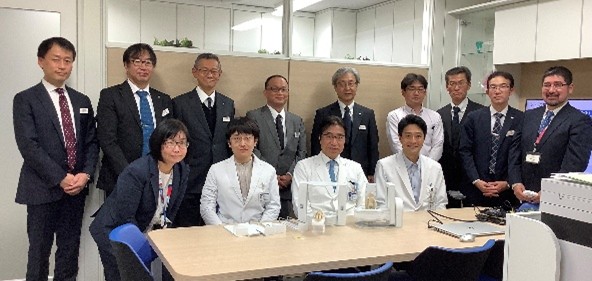
Center: Masahiro Jinzaki, left: Takeo Nagura, right: Naomichi Ogihara, and Canon Medical staff on both sides.

Clinical Research Using Upright and Sitting CT
In May 2017, the first upright/sitting CT unit was installed at Keio University Hospital. Under Professor Jinzaki’s leadership, a research group was organized, including Associate Professor Yoshitake Yamada, Dr. Minoru Yamada, Assistant Professor Yoichi Yokoyama, and Dr. Nagura. A specific clinical research program was launched using this system.
Collaborations extended across multiple departments—including neurosurgery, respiratory medicine, thoracic surgery, cardiology, cardiac surgery, gastroenterology, general surgery, urology, gynecology, orthopedics, and plastic surgery—to elucidate human anatomical structures under gravity and to reveal organ positional shifts dependent on posture. Numerous reports have demonstrated the clinical utility of this system, including the visualization of disease conditions unrecognizable on conventional supine CT.
Advantages of upright imaging include:
- Improved examination workflow
- Fully contact-free and remotely operated scanning, reducing infection risk
- Diagnosis of posture-dependent symptoms or abnormalities that appear only when standing
- Early detection of load-bearing musculoskeletal disorders
- Assessment of pelvic floor relaxation
- Longitudinal evaluation of posture and muscle mass
- Functional assessment of swallowing, gait, and urination
- Application to sitting-position radiotherapy
Following its introduction at the Keio University Hospital main campus in 2017 (Fig. 6), the system was also installed at the Keio University Preventive Medicine Center in 2023, where it is now being utilized for preventive care aimed at extending healthy longevity.

Development of Multi-Position CT
Around 2020, in parallel with the clinical studies of the upright/sitting CT, the team—together with Canon Medical Systems—continued regular meetings to pursue the original goal: a multi-position CT system capable of imaging in the supine, sitting, and standing positions (Fig. 7).
To achieve this, the system adopted a cantilever-type gantry structure, supported from one side instead of both, ensuring stability and openness. For enhanced patient safety and usability, infrared area sensors were incorporated to detect abnormal movements, and a mechanism allowing the gantry to tilt 14 degrees forward was developed to facilitate patient entry in the standing position.
In 2025, the multi-position CT “Aquilion Rise” was officially released, capable of scanning in all three positions—standing, sitting, and supine (Figs. 8 and 9). The world’s first clinical unit was installed at Keio University Hospital, where ongoing clinical studies are underway.


Fig.9 Three scanning positions – sitting, standing, and supine
Reference
- Jinzaki M, Yamada Y, Nagura T, et al. Development of Upright Computed Tomography With Area Detector for Whole-Body Scans. Investigative Radiology 2020;55(2):73-83. doi: 10.1097/rli.0000000000000603.
- Jinzaki M, Yamada M, Yokoyama Y, et al. Upright MDCT with 320 Detector-Row Gantry: A Technical Innovation Providing Insights into Human Anatomy Under Gravity and Potential Clinical Implications. Br J Radiol. 2025. Aug 26:tqaf196. doi: 10.1093/bjr/tqaf196. Online ahead of print.
- Schiebler ML, Jinzaki M, Yanagawa M, et al. Future Applications of Cardiothoracic CT. Radiology. 2025 Jun;315(3):e240085. doi: 10.1148/radiol.240085.